
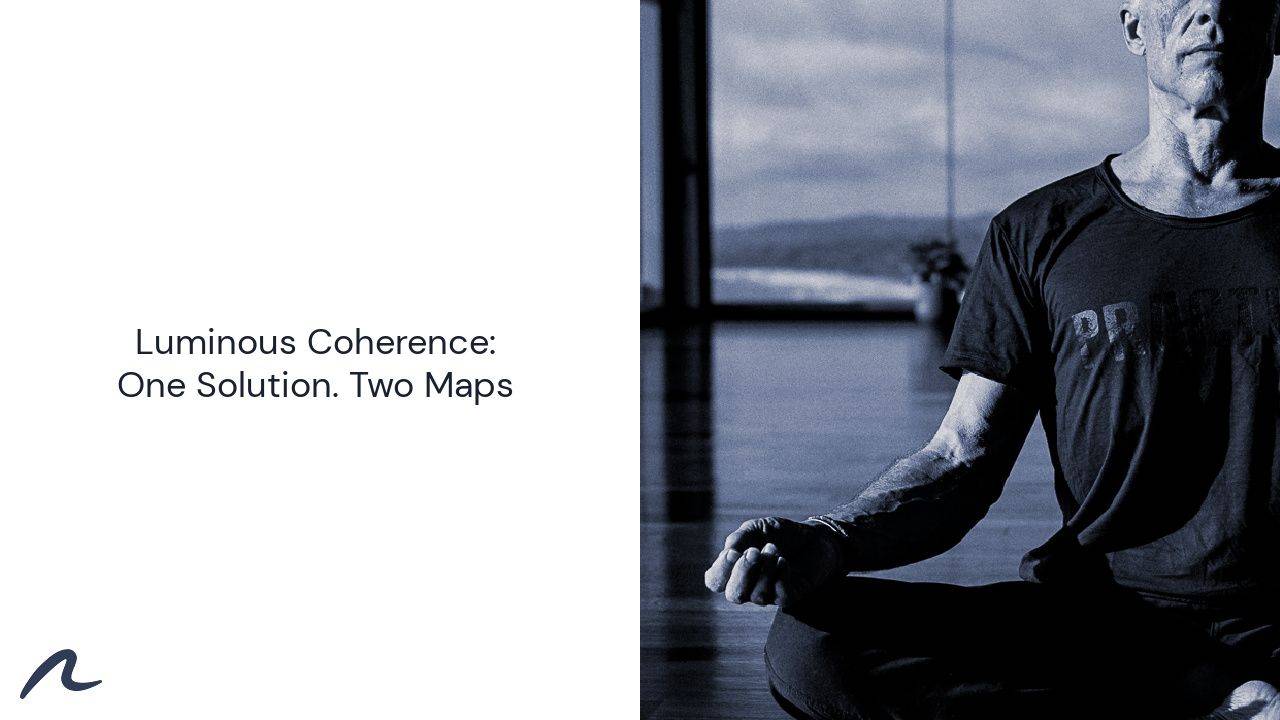
Two years ago, I had a profound epiphany: three specific points in the brain and body, mapped by tantric practitioners thousands of years before anyone had a brain scanner, correlate to what modern neuroscience calls the default mode network — the machinery behind every looping thought and repeated emotion you've never quite been able to shake. That convergence, between an ancient map and a modern one, is where Luminous Coherence began. All of which has culminated — for me, and for nearly everyone who has dedicated themselves to the method since I began sharing it — in a freedom that even years of dedicated meditation practice never unlocked.
The Reckoning
Decades of practice, and one day I realized I was looping the same non-constructive thoughts. The same hurts. The same sadness and disappointments I would have hoped, by then, to be past and over.
That recognition didn't come easily. It's not a small thing to look at four-plus decades of daily discipline and admit it wasn't yielding what you'd assumed it would. I'd been meditating almost every day since my twenties. I'd taught thousands of people how to do the same. And I was still, on certain days, exactly as tethered to old disappointments as I'd been years earlier.
So I had to look at the practice itself. What was meditation, actually? What was it promising? What was its real intention? And why, after everything, wasn't it setting me free from repetitive emotional thought and behavior?
It would have been easier to conclude I simply hadn't practiced hard enough, or long enough, or with enough discipline. I've since talked with enough serious practitioners — people decades into their own practice — to know that conclusion is usually wrong. The issue wasn't effort. It was that meditation, as most of us have inherited it, was never fully built to do the thing I was asking of it.
The Pivot
I didn't look for an answer in another retreat or a more advanced technique. I pivoted to neuroscience.
I took my forty-plus years of practice and teaching and went looking through cognitive behavioral therapy and brain science for what might actually explain the gap I was living inside of. What I found were correlates — powerful, specific ones — between what neuroscience says about how the brain actually learns, and teachings buried inside the tantric yoga and meditation tradition that most modern practitioners, myself included for most of my life, had never fully connected to anything clinical.
That convergence became the basis for Luminous Coherence.
Three Centers, One Loop
Part of what I found were three distinct centers — in the brain, and in the subtle body the tantric tradition maps alongside it. Talu, at the soft palate. Bindu visarga, at the back of the skull. The guru chakra, at the crown. They're not well known, even among serious practitioners. I first learned them decades ago, at different points, from two different teachers, long before I had any language for what they were actually doing.
It wasn't until about two years ago that I found the correlation that stopped me cold: those same three centers line up with what neuroscience calls the default mode network. If you've ever caught yourself looping the same thought, the same emotion, again and again, uninvited — you can credit the default mode network for it. It's the machinery of rumination, of self-narrative, of the mind replaying what it already knows, long after the original moment has passed.
Working with those three centers is how we enter a state of coherence. In coherence, there's no past, no future pulling at you. No worry, no stress in the way we usually carry it. Just oneness. Wholeness.
But coherence on its own was never going to be the whole answer. The trick isn't to let it simply stand there, untouched, a nice place to visit between the hard parts of life. The real work is learning to compassionately — even tenderly — bring the real emotions you and I actually live with into that space. Your actual triggers. Not a sanitized version of them.
That meeting point, between coherence and whatever is really alive in you, is where the change happens. Introduce a trigger into that field tenderly enough, and watch it change. Not just in that moment — in how you respond to your entire life from there forward.
Why Change Is the Hardest Thing We Do
There may be nothing more challenging for us as human beings than change. Look at the stressors we name for ourselves most often: divorce, a career shift, retirement, the death of someone we love. Underneath every one of them is the same fact — something changed, and we didn't choose it.
We live in a universe that doesn't stop changing, often in directions we'd prefer it didn't. From there, we really only have two options.
One: we let resentment, frustration, sadness, even fear, quietly accumulate around the world as it is. Because these things do accumulate. We become more easily triggered as time goes on, not less — more sensitized, not more resilient.
The other option isn't to find some place to transcend the world entirely, which has long been meditation's favorite move. It's to actively invite the stressors — the real ones — into a unified state of awareness. From there, something genuinely shifts. We become comfortable with change itself. Instead of generating conflict, fear, and sadness, change stops feeding the old loop of familiar thought, emotion, and behavior.
In other words: we become free.
What I've Watched Happen Since
In the year and a half I've been teaching this approach, the results — and the evidence we've since gathered through formal outcomes research — have been remarkable. Experienced meditators, people who've been doing this work for a decade or longer, are reporting something they hadn't felt before: real freedom. More capacity. A spontaneity that all those years of dedicated practice alone had never quite unlocked. Even among practitioners with ten or more years of daily meditation behind them, we've measured statistically significant shifts in reactivity and rumination — not a placebo-sized bump, but changes large enough to be hard to dismiss.
That's not a small claim, and I don't make it lightly. I spent most of my adult life inside serious, sustained meditation practice, and I know exactly how good that practice can get you at feeling calm, feeling clear, feeling — for a while — free. What I didn't know, until I went looking, was how much of that calm evaporated the moment I stepped back into the actual conditions of my life. The old patterns were still there, running underneath, waiting for the next trigger.
I don't say any of this to diminish what meditation has already given you, if you've practiced for any real length of time. It gave me the same things — clarity, resilience, real moments of genuine peace. What it hadn't given me, despite everything, was a way to actually revise the old patterning itself. That distinction turned out to matter more than I expected.
Luminous Coherence was built to close that specific gap. Not to give you one more beautiful state to visit. To change what happens once you leave it.
Why Live, and Why Together
None of this happens in isolation, either. I teach this live, in real time, alongside a cohort of people doing the same work on the same schedule — not because a recording couldn't carry the technique, but because something changes when a room full of people are all bringing their real triggers into coherence together. Questions get asked live that surface things solo practice rarely surfaces. Hearing someone else's process, unscripted, in real time, has a way of clarifying your own.
That's not incidental to the results we've measured. It's part of them.
If This Sounds Familiar
If any of this speaks to you — the particular frustration of having done the work, meditated, sat, breathed, and still not feeling free of the patterns you assumed by now you'd be past — I'd invite you to look at the next round of Luminous Coherence.
Two maps, thousands of years apart, pointing at the same three places. And for nearly everyone who has walked through this with me so far, a kind of freedom that decades of practice alone never quite delivered.

